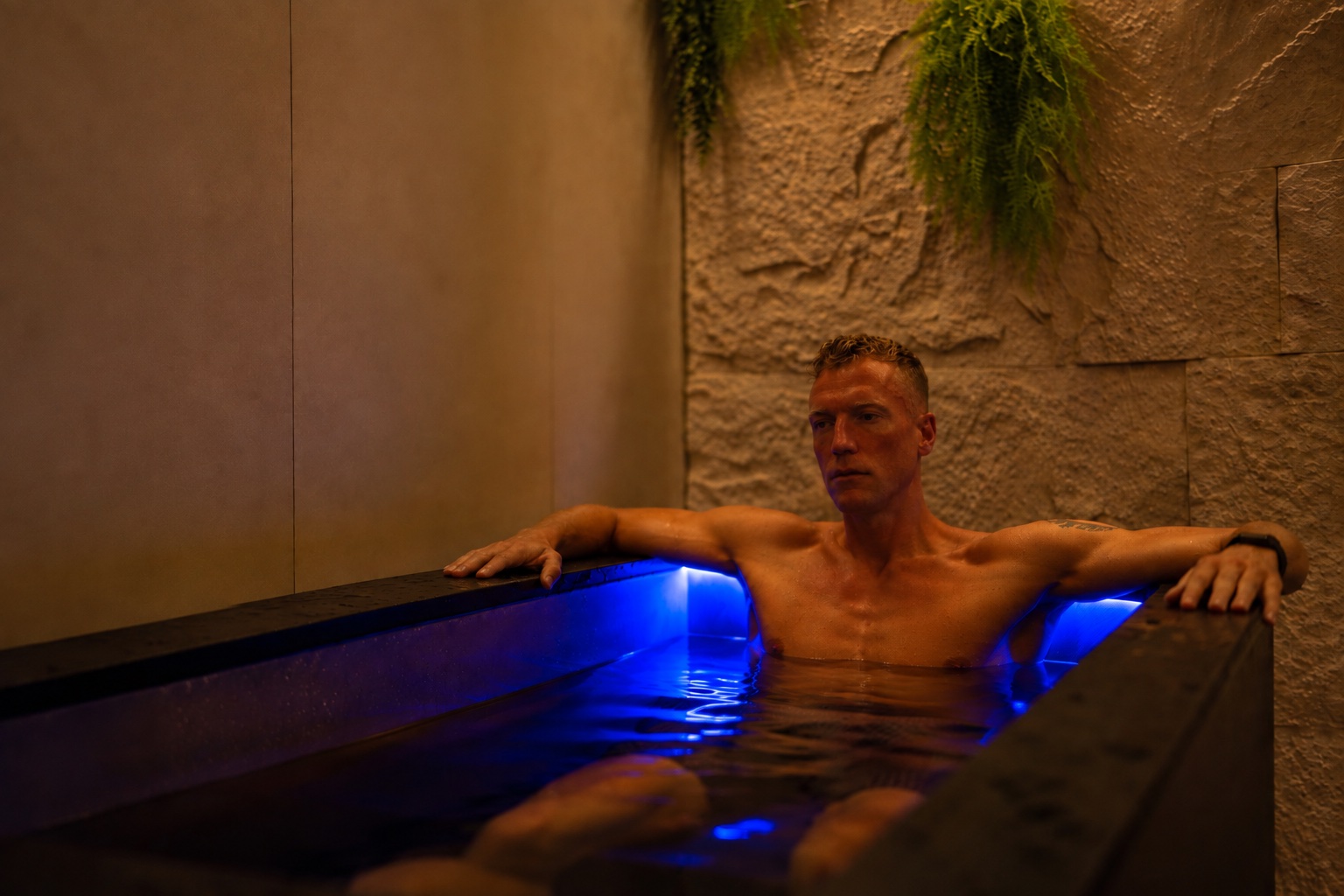
Cold plunges work, but they work for one goal and quietly work against another, and almost nothing written about them says which is which.
Get out of a cold plunge after a hard endurance session and you'll recover faster. Get out of one after a heavy lifting session built for strength or size, and you've just told your body to grow less from the work you did. Same fifteen minutes. Opposite outcome, depending on what you did beforehand.
Cold water immersion has also become shorthand for toughness online: a plunge before sunrise, filmed and posted, treated as proof of character. Set that aside. What actually matters is narrower and more useful: what the research shows this does, and when you should leave it alone.
The real case for it
A Cochrane review of cold water immersion after exercise, 17 trials and 366 participants, found some evidence it reduces delayed-onset muscle soreness compared with rest alone. A 2025 network meta-analysis of 55 trials found the same effect on creatine kinase, the blood marker most associated with muscle damage. The mechanism is fairly direct: cold-induced vasoconstriction limits swelling and secondary tissue damage in the hours after hard training, and the drop in local tissue temperature slows the inflammatory cascade that drives soreness.
Duration matters more consistently than exact temperature within the ranges studied. Most of the benefit clusters around 10 to 15 minutes, whether the water sits at 10°C or 15°C.
One thing worth being straight about: nobody in these studies can be blinded, you know when you're in cold water, and placebo-controlled work shows some of that soreness relief is expectation, not physiology. The effect is real. It's just smaller than the best-case studies make it look.
Why you feel sharp afterwards
There's a second effect worth knowing, separate from muscle recovery entirely. A well-known study in the European Journal of Applied Physiology found that a single session in 14°C water produced a sharp, multi-fold increase in circulating norepinephrine and dopamine, alongside measurable drops in heart rate, blood pressure and cortisol. That finding comes from one small, frequently-cited study, not a large replicated body of work. The direction holds: cold exposure spikes both. The exact multiplier varies by source, so don't anchor to a specific number.
Cold exposure is a genuine sympathetic stressor. Your body responds to the thermal threat with the same systems that respond to any acute stressor, which is exactly why the catecholamine spike happens. What's unusual is what happens alongside it: research on heart rate variability shows cold water immersion also improves parasympathetic reactivation, the vagal, "rest and digest" side of your nervous system, at the same time the sympathetic side is firing. Sympathetic and parasympathetic activation together, not one replacing the other. That combination, alert and calm simultaneously, is the actual mechanism behind the feeling people struggle to describe after getting out.
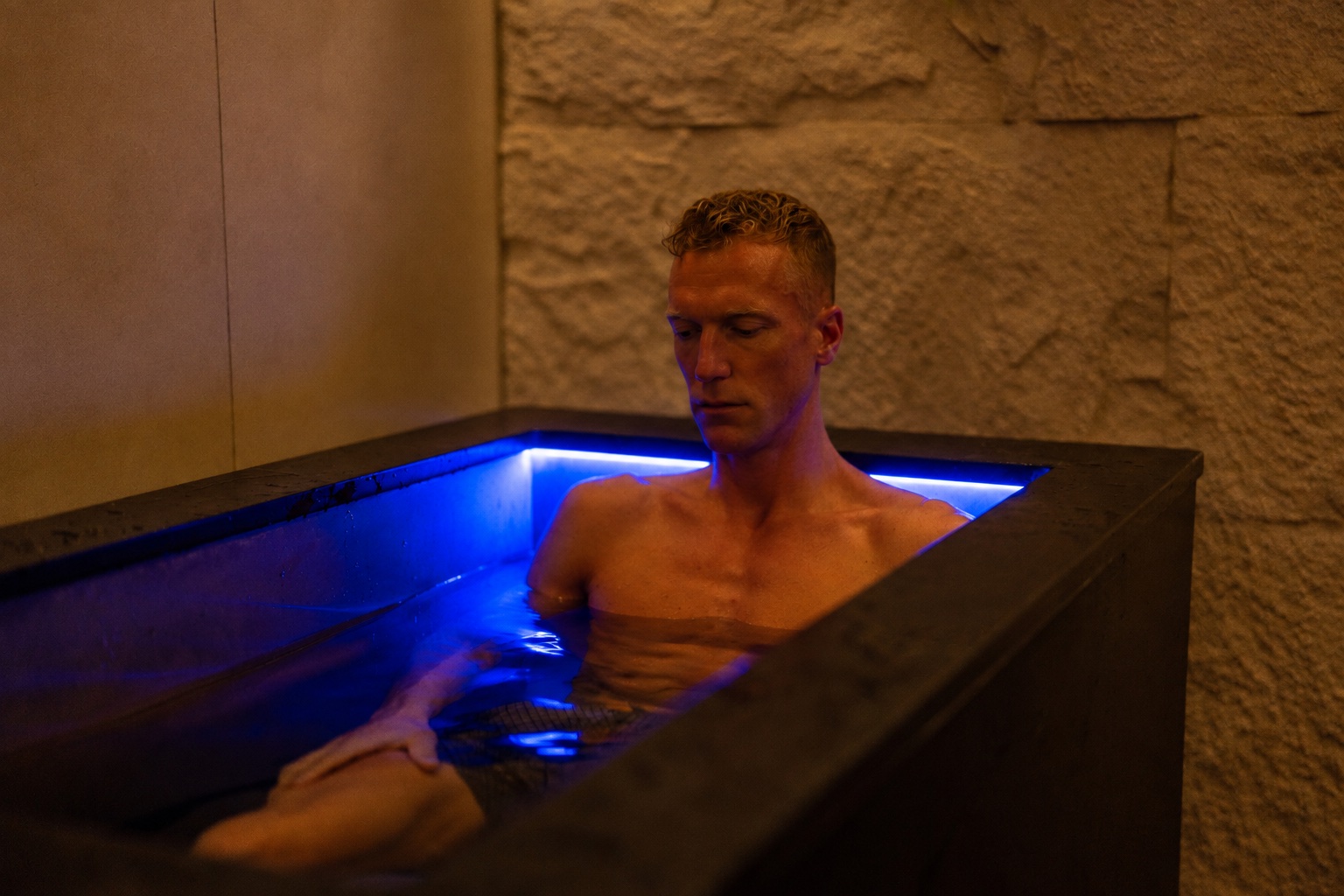
For anyone whose week involves landing somewhere new and needing to be sharp within the hour, that's a genuinely useful tool, and it's not the same tool as caffeine, which only pulls the sympathetic lever.
Where it works against you
A 12-week trial in The Journal of Physiology found that men doing regular cold water immersion after resistance training gained less strength and less muscle than men who used active recovery instead, a detail almost nobody selling cold plunges mentions. Follow-up work identified the mechanism precisely: cold water immersion attenuates the phosphorylation of p70S6 kinase, a key step in the mTORC1 pathway your body uses to signal muscle protein synthesis after a session. Ten minutes at 10°C was enough to blunt it.
The strength finding isn't as consistently replicated as the muscle-growth finding. A separate trial found similar strength gains between groups even though muscle growth was still blunted. Treat the growth effect as the solid one here, the strength effect as the less certain one.
The same anti-inflammatory effect that reduces soreness also mutes the signal your muscles use to know they need to adapt. Inflammation after resistance training isn't just discomfort to be minimised, it's part of the message. Numb that message consistently, right after the sessions where strength or hypertrophy is the actual goal, and you're working against your own investment without realising it.
This is the best-replicated finding in this piece. A 2024 meta-analysis confirmed the direction, and the underlying studies are still only fair to poor in quality individually. Of the four claims here, this is the one I'd bet on.
How to actually use it
The right approach depends entirely on what the session in front of you was for.
Cold water immersion earns its place. 10 to 15 minutes, somewhere in the 10 to 15°C range, is where the evidence clusters. There's early evidence it may even enhance some of the underlying mitochondrial signaling from that session, though it hasn't yet shown up as a measurable performance gain, so treat that as interesting rather than a reason on its own.
Skip it, or push it to several hours later or a separate day. Active recovery, easy movement, mobility work, does the job without interfering with the signal you just worked to create.
A genuinely cold shower for the same duration produces a meaningfully smaller version of the same response. Not equivalent, but not nothing, and it travels with you.
Cold immersion triggers a real cardiovascular response, an initial gasp reflex and a spike in heart rate and blood pressure, which is a genuine risk for anyone with hypertension or existing cardiac issues. If that's you, get clearance first. For anyone starting fresh, the response reliably settles with habituation, the first three to five short sessions are where most of the shock response fades, so start at a higher temperature and shorter duration than you think you need, and don't do your first few sessions alone.
The actual point
Cold water immersion is a tool that does one job well and a different job badly, not a discipline test or a stack to perform. The entire value of using it is knowing which job you're actually asking it to do before you get in.
Want a system built around your actual week?
Optima Axis is private coaching for people whose training, travel and recovery need to work together, not against each other.
Join the Waitlist